
The Emotion-First Creative Strategy: Choosing Clips by Feeling, Not Format
Flip your UGC creative process: start with the target emotion, then select format and creator for stronger ad performance.
Most media buyers build ads format-first. "We need a GRWM video." "Let's do a reaction clip." "Get me a testimonial." Then they find a creator who can deliver that format and hope the emotion lands.
This is backwards. The emotion is what performs. The format is just the container.
Human-led emotional storytelling produces 3.2x stronger emotional response than AI avatar content (Industry data/HubSpot). But "emotional storytelling" isn't a format. It's a strategic choice about what the viewer should feel, made before you decide how to make them feel it.
Here's how to flip the process.
The Format-First Trap
When you start with format, you constrain the emotional range before you've even considered what your campaign needs. "We need a GRWM" limits you to conversational, mid-energy emotions. "We need a reaction clip" biases toward surprise or shock. "We need a testimonial" pushes toward rational endorsement.
Sometimes those constraints align with what your campaign actually needs. Often they don't. The media buyer who defaults to reaction clips for every campaign misses the skepticism-to-conviction arc that would work better for consideration-stage audiences. The brand that always commissions testimonials misses the raw emotional hook that would stop the scroll at the top of funnel.
Format-first thinking also creates a sameness problem. If your competitor is also running reaction clip hooks (they are), and you're both sourcing surprise reactions (you probably are), the format becomes invisible. It blends into the feed. The only differentiator left is the specific emotion and how authentically it's delivered.
The Emotion-First Framework
Starting with emotion means asking a different opening question. Not "what format should we use?" but "what should the viewer feel?"
Step 1: Map the Funnel Stage to an Emotional Target
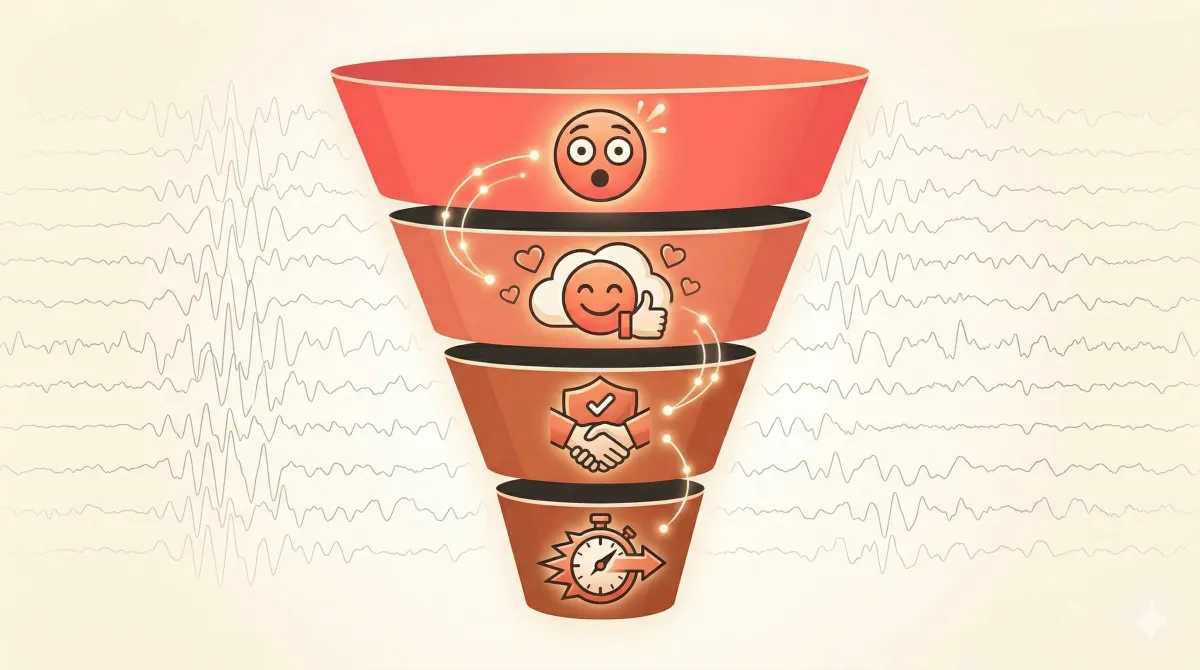
Different funnel stages require different emotional work from your creative.
Top of funnel (awareness): The viewer doesn't know you. The emotion's job is to interrupt their pattern and create curiosity. Target emotions: surprise, shock, dramatic curiosity, "wait what?"
Mid funnel (consideration): The viewer knows the problem. The emotion's job is to build trust and reduce skepticism. Target emotions: skepticism-to-conviction, relatable frustration, impressed discovery
Bottom funnel (conversion): The viewer is close to buying. The emotion's job is to provide the confidence push. Target emotions: delight, satisfaction, tearful joy, "I can't believe this works"
Retention/loyalty: The viewer is already a customer. The emotion's job is to reinforce their decision. Target emotions: pride, belonging, excited anticipation
Step 2: Choose the Specific Emotion
Within each funnel stage, there are multiple emotions that could work. The full emotion taxonomy maps these in detail. But here's the practical selection process.
Ask: "If I could make the viewer feel ONE thing after seeing this ad, what would it be?"
Not "interested in the product." That's an outcome, not an emotion. The emotion is the vehicle to that outcome.
Examples:
- "I want them to feel the FOMO of missing something everyone else is discovering" → Excited surprise from a creator
- "I want them to feel like someone gets their frustration" → Relatable skepticism, followed by relief
- "I want them to feel reassured that this actually works" → Genuine delight from someone who's tried it
- "I want them to feel the intensity of a real transformation" → Tearful joy or stunned disbelief
Each of those emotional targets points to a very different clip, even if the product and audience are the same.
Step 3: Select Format Based on the Emotion
Now, with your emotional target locked, you pick the format that best carries that emotion.
Surprise/shock: Reaction clip. The format is built for this. Short, punchy, face-forward Skepticism-to-conviction: Testimonial or GRWM with an arc. Needs duration for the shift to happen Relatable frustration: GRWM or "day in my life" format. Casual, low-production feel Delight/satisfaction: Unboxing reveal or testimonial. The format needs a moment of discovery Tearful joy: Reaction clip or testimonial. Close-up framing to capture the emotion
See how the format becomes obvious once the emotion is clear? You're not choosing between reaction and testimonial in the abstract. You're choosing the container that best delivers "stunned delight" or "slowly dissolving skepticism."
Step 4: Select Creator Based on Emotional Fit
The final variable is the creator. With emotion-first thinking, you're not looking for the "best" creator in general. You're looking for the creator who delivers your specific target emotion most authentically.
Some creators are expressive maximalists: big reactions, dramatic facial movement, high energy. They're perfect for surprise hooks and excitement. Others are understated and conversational: subtle expressions, relatable energy, naturalistic delivery. They're better for skepticism arcs and GRWM formats.
Video marketplaces like LatinaUGC let you filter directly by emotional style, so you're searching for "understated delight from a Latin creator" rather than scrolling through hundreds of clips that don't match your brief.
Reaction videos stop the scroll because of authentic emotional expression, not because of format conventions. A creator who genuinely delivers "impressed but trying to stay cool" is more valuable for your consideration-stage campaign than a creator with more followers who defaults to over-the-top surprise.
Emotion-First in Practice: Three Scenarios
Scenario 1: Skincare Brand, Top of Funnel
Format-first approach: "Let's do a reaction video to our new serum." Result: Generic surprised face, interchangeable with every other skincare reaction clip.
Emotion-first approach: "We want viewers to feel the 'oh, my skin has never looked like this' disbelief." Format selected: Close-up reaction clip, but specifically the slow-dawning realization, not the big surprise. The creator touches their face, looks closer in the mirror, and their expression shifts from casual to genuinely stunned. Result: A clip that feels different from the thousands of "OMG" reactions in the skincare space.
Scenario 2: SaaS Product, Mid Funnel
Format-first approach: "We need a testimonial about our dashboard." Result: Creator talks through features. Informative but emotionally flat.
Emotion-first approach: "We want the viewer to feel the relief of finally having a tool that actually works." Format selected: Testimonial, but briefed for the emotional arc: start with the frustration of the old workflow, then the moment of discovery, then the visible relief. The emotion is "I can't believe I dealt with the old way for so long." Result: A testimonial that converts because the viewer recognizes their own frustration in the creator's performance.
Scenario 3: DTC Fashion, Bottom of Funnel
Format-first approach: "Let's do a GRWM with the new collection." Result: Standard styling video. Pretty but doesn't push the conversion button.
Emotion-first approach: "We want viewers to feel the confidence boost of putting on something that just works." When you place a custom order briefed around that specific emotion, the creator has a clear internal target — not a script, but a feeling to hit. Format selected: GRWM, but briefed for the specific moment: the creator puts on the piece and their posture changes. They stand taller. They do a little spin. The emotion is quiet confidence, not performance. That authentic "FaceTime call" intimacy makes the difference. Result: A GRWM that converts because the viewer wants to feel what the creator is feeling.
Why This Matters for Performance
The data is clear. Human-led emotional content produces 3.2x stronger response than alternatives. But "emotional content" is a spectrum. A mildly pleasant testimonial is technically emotional. A clip that makes the viewer's stomach flip with desire or relief is also emotional. The performance gap between those two is enormous.
Emotion-first strategy is how you consistently land on the high end of that spectrum. When you start with the specific feeling you want to create, every subsequent decision (format, creator, duration, pacing) serves that feeling. When you start with format, you're hoping the emotion shows up on its own.
Hope is not a media buying strategy.
Building an Emotion-First Library
The practical implication of emotion-first thinking is that you organize your clip library by emotion, not by format. This is exactly the taxonomy that a well-structured UGC marketplace applies: authentic content from real creators, searchable by the feeling you need to produce.
When you browse for new clips, filter by emotion first. Build a folder structure that mirrors your funnel stages and emotional targets:
- Hooks/Awareness: Surprise, shock, curiosity, "wait what?"
- Consideration: Skepticism, frustration, impressed discovery
- Conversion: Delight, satisfaction, tearful joy, confidence
- Retention: Pride, belonging, excitement
When it's time to build a new ad, start in the right emotional folder. The format and creator reveal themselves.
Real creators. Real emotion. Ready to test in your next campaign. Browse the Catalog →
 The emotion is what performs. The format is just the container.
 Different funnel stages demand different emotional work from your creative.
Sources
- Industry data/HubSpot, "Human-led emotional storytelling 3.2x stronger response than AI avatars," Recent
- Animoto, "State of Video 2026 Report (43% say personal and authentic most important)," January 2026
- InFront Marketing, "Neuroscience of Visual Attention in Advertising," Recent
- Wyzowl, "2024 Video Marketing Statistics (68% prefer human faces for emotional content)," 2024