
Human Presenters + Native Overlays = +5-10 Points Hook Rate: The SendShort Study
SendShort's 6-brand analysis found human presenters with native overlays add 5-10 points to hook rate. Here's what the study found and how to apply it.
SendShort analyzed six brands' video ad performance and found a clear winner: human presenters combined with native overlays add 5-10 percentage points to hook rate. On a Meta baseline of 20-25% (Vaizle 2025), that single creative variable can be the difference between below-average and top-tier performance.
The study is one of the more practical pieces of hook rate research available because it isolates the presenter variable. Same brands, same products, same platforms. The change was what the viewer saw in the first few seconds.
What the 6-Brand Analysis Found
SendShort's analysis compared creative variants across six brands to identify which elements most consistently improved hook rate. The finding was specific: human presenters, meaning real people on camera rather than text-only, product-only, or animation-based openings, combined with native overlays (platform-typical text formatting rather than heavy graphic design) produced the strongest results.
The 5-10 point improvement is not a modeled estimate. It was the observed difference across brands when the presenter variable was introduced or optimized. To put that in perspective with other hook rate benchmarks: that improvement can move a campaign from the bottom quartile to the top quartile on Meta.
Why the Combination Works
The neuroscience explains the "human presenter" half clearly. The brain locks onto eyes and expressions in under a second (InFront Marketing). The 170-millisecond face detection response means a human face in the first frame activates attention systems before any other creative element can compete.
The "native overlay" half is equally important and less obvious. Native overlays, meaning text that matches the look and feel of organic content on the platform, signal that the content is user-generated rather than polished advertising. This triggers a different evaluation mode in the viewer.
On platforms like TikTok and Instagram Reels, viewers have learned to distinguish between "content I chose to see" and "content someone paid to show me." Native formatting blurs that distinction. The human presenter provides the face-first attention capture. The native overlay prevents the immediate "this is an ad" categorization that causes viewers to scroll past.
Together, they create an opening that is both attention-capturing (face) and non-threatening (native format).
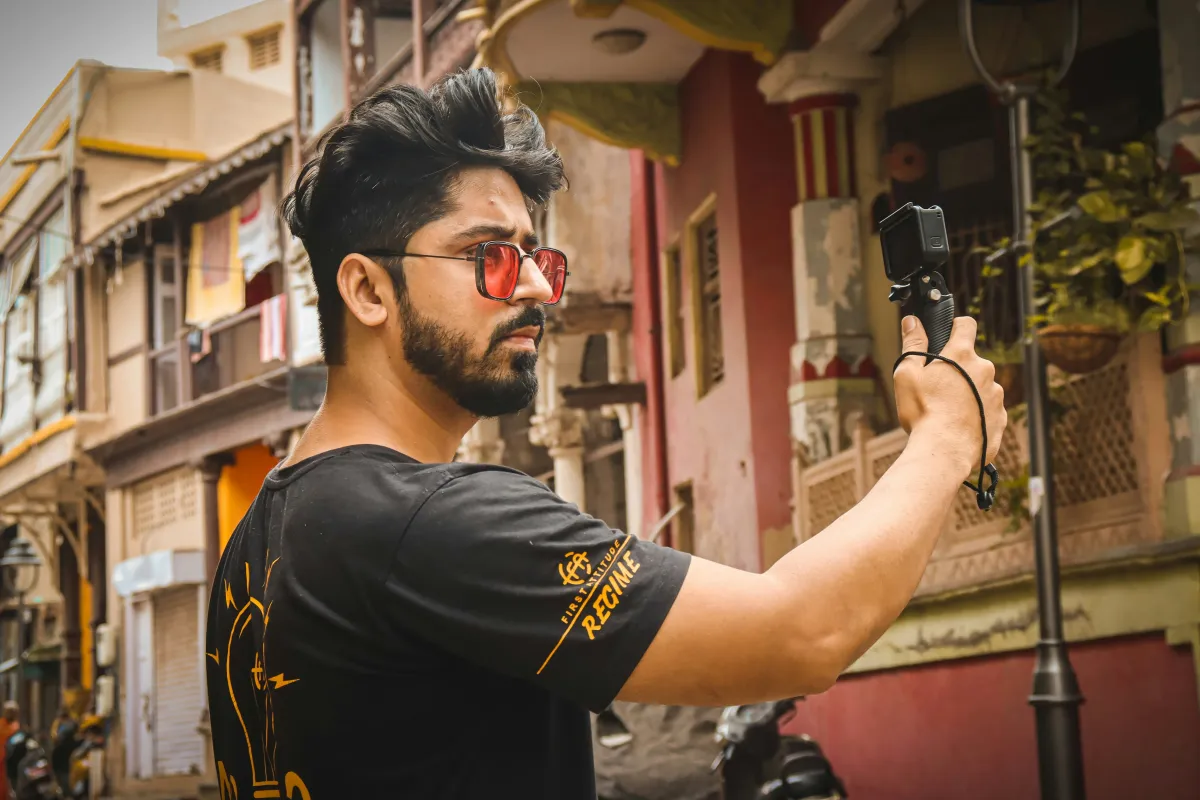 Photo by Aejaz Memon on Unsplash
The combination of real presenter and native formatting mirrors organic content patterns that viewers engage with naturally.
Photo by Aejaz Memon on Unsplash
The combination of real presenter and native formatting mirrors organic content patterns that viewers engage with naturally.
The Real vs. AI Presenter Gap
SendShort's study measured real human presenters, not AI-generated ones. The distinction matters.
Animoto's 2026 data found that consumers identify robotic gestures (67%), unnatural voices (55%), and lack of emotional tone (51%) as primary AI tells. A ScienceDirect study (2024) showed that human voice-over reduces cognitive load and enhances purchase intention compared to AI voice. These findings suggest that the presenter advantage documented by SendShort is specifically a real human advantage, not a generic "face on screen" advantage.
An AI presenter might capture the initial eye fixation (a face is a face to the FFA at first glance). But the cognitive load difference means the advantage degrades within seconds as the viewer's brain processes the voice and expression as less natural. The University of Sydney's EEG work (2022) showed this happens at the subconscious level: neural response differences are present even when viewers do not consciously identify the face as synthetic.
The 5-10 point hook rate improvement from SendShort is the real-presenter improvement. The improvement from an AI presenter would likely be smaller, and the downstream retention would likely be worse, because the initial attention capture is not sustained by the same trust and emotional engagement mechanisms.
How to Apply the SendShort Findings
The study points to a specific creative formula: real human, looking at camera, with native-style text overlay. Here is how to execute it.
The Presenter
Use a real person who fits your target audience's peer group. Animoto's 2026 data shows 43% of consumers rate "personal and authentic" as the most important video quality. A creator who looks and sounds like someone the viewer might actually know outperforms a polished spokesperson. For brands targeting Spanish-speaking or multicultural audiences, Latina creators deliver this peer-group resonance with the added cultural specificity that generic UGC often misses.
The expression matters. The first-frame science shows that the initial facial expression drives the stop/scroll decision. An emotionally charged opening (surprise, excitement, curiosity, mild skepticism) outperforms a neutral talking head.
The Overlay
Keep text minimal and format it like organic content on the platform. On TikTok, that means the default caption style. On Instagram Reels, the native text tool. On Facebook, simple bold text without heavy design elements.
The text should reinforce the hook, not replace it. "Wait, this actually worked?" over a surprised face doubles the hook: the expression stops the scroll, and the text gives the viewer a reason to stay. The text should not be the primary attention driver. The face is.
The Combination
The presenter and overlay should feel integrated, not layered. The text appears because the person is saying something worth highlighting, not because a designer placed it. This subtle distinction is the difference between native and non-native creative, and it is the difference between triggering "content" mode and "ad" mode in the viewer's evaluation.
 Native overlays signal organic content, lowering the viewer's ad-detection guard.
The Testing Opportunity
SendShort's 5-10 point range (not a single number) implies variation across brands. Some brands saw closer to 5 points of improvement. Others saw closer to 10. The difference likely depends on the baseline creative (brands starting from weaker baselines see larger improvements) and the presenter-audience fit.
This makes it a testable variable. The framework is straightforward: take your current best-performing ad, create variants with different real presenters in the opening, add native-style text overlays, and compare hook rates.
The brands reaching top-quartile performance (40-45% on TikTok per Tuff Agency, 30%+ on Meta per Vaizle) are not using a single presenter. They are testing multiple presenters and finding the ones that resonate with their specific audience. Having access to a diverse pool of creators to test against is what turns a one-time improvement into a sustained advantage. LatinaUGC's video marketplace is built for exactly this use case — a clip library of authentic reaction content from Latin creators, with commercial rights cleared, so testing multiple presenter options doesn't require multiple production weeks.
The Bottom Line
SendShort's study confirms what the neuroscience predicts: a real human face in the first frame, combined with platform-native formatting, is the highest-leverage hook rate variable available to media buyers. The 5-10 point improvement is significant, actionable, and testable.
The next step is not to take this as a rule and apply it rigidly. It is to treat it as a starting hypothesis and test it with your own audiences, your own products, and a variety of real creators.
Real creators. Real emotion. Ready to test in your next campaign. Browse the Catalog →
Sources
- SendShort, "Hook rate analysis (6-brand study)"
- Vaizle, "Meta ads hook rate benchmarks," 2025
- Tuff Agency, "TikTok hook rate analysis (11 accounts)"
- Animoto, "State of Video 2026 Report," January 2026
- InFront Marketing, "Neuroscience of visual attention and eye fixation"
- University of Sydney, "EEG detection of deepfake faces," 2022
- ScienceDirect, "Cognitive load: human vs AI voice-over," Journal of Retailing and Consumer Services, 2024