
The Uncanny Valley Is Real, And It's Destroying Your Ad Performance
The uncanny valley isn't just for robots. AI-generated b-roll triggers subconscious discomfort that tanks your hook rate and brand trust.
In 1970, roboticist Masahiro Mori proposed a simple idea: as a robot becomes more human-like, people respond more positively to it. But there's a dip. At a certain point, when the robot is almost human but not quite, the emotional response turns sharply negative. People feel unease, discomfort, even revulsion. Mori called this dip the uncanny valley.
Fifty-five years later, the uncanny valley has escaped the robotics lab. It now lives in your ad feed. Every AI-generated face, every synthetic reaction clip, every algorithmically produced b-roll of a "person" reacting to a product sits squarely in that valley. And the performance data shows it.
Why the Valley Exists
The uncanny valley isn't a design flaw or a taste preference. It's a product of how the human brain processes faces.
Your brain has a dedicated region for face processing: the fusiform face area (FFA), located in the ventral occipito-temporal cortex. It responds with high selectivity to faces and activates automatically. You don't choose to process a face. It happens before conscious thought begins.
When the FFA encounters a face that is almost real but slightly off, it creates what researchers call a perceptual mismatch. The eyes might look realistic, but the skin texture doesn't match. The facial proportions are close to normal, but the spacing between features is subtly wrong. The expression is technically correct, but the micro-movements that accompany genuine emotion are missing.
fMRI brain imaging at UCSD confirmed what this feels like from the inside. Researchers found that the brain "lights up" differently when human-like appearance and robotic or synthetic motion don't match. The parietal cortex, specifically the areas connecting visual processing with motor cortex mirror neurons, shows a mismatch response. Your brain is trying to predict how a real face should move based on how it looks, and when the prediction fails, it generates discomfort.
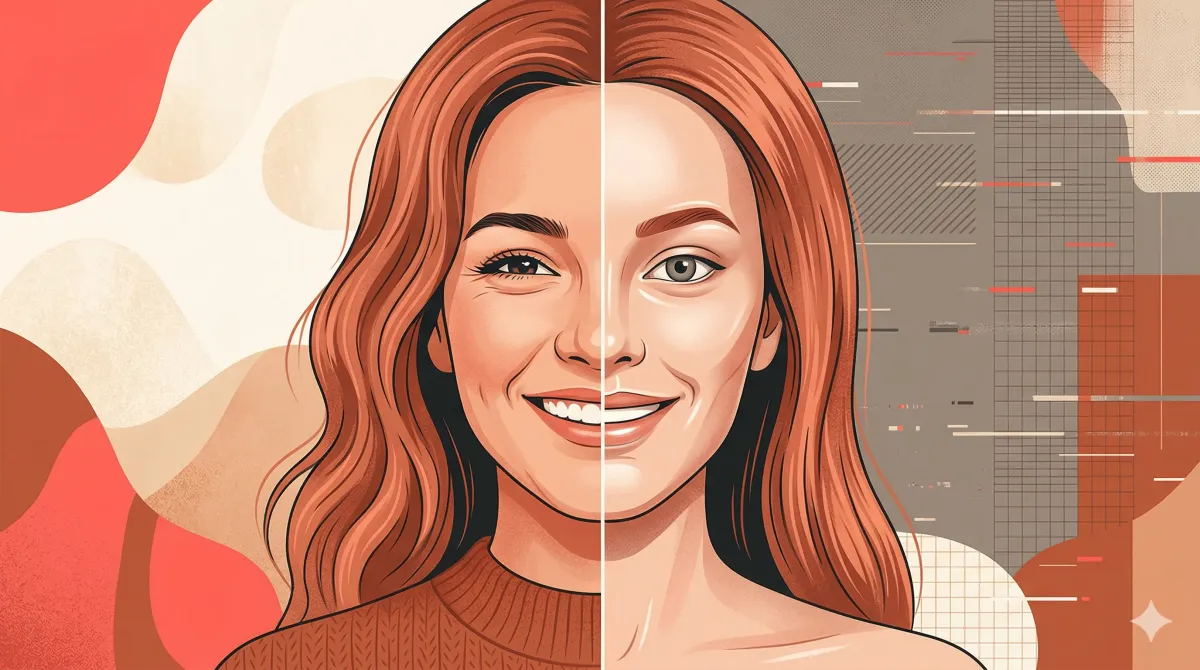 The brain's face processing system generates discomfort when appearance and motion don't align.
The Valley in AI-Generated Content
The uncanny valley was originally described for physical robots. But a systematic review published in ScienceDirect confirmed that virtual faces are judged eerier than real faces, and that this perception of uncanniness is associated with negative emotions and avoidance behaviors.
This matters enormously for AI video tools. Current AI face generation has improved dramatically in visual fidelity. Runway's Gen-4.5 produces clips that are often indistinguishable from real footage at a casual glance. But "indistinguishable at a casual glance" is not the same as "processed identically by the brain."
Research from the University of Sydney using EEG demonstrated that the brain's N170 component, which fires approximately 170 milliseconds after seeing a face, responds differently to real and AI-generated faces. This happens below the level of conscious awareness. Participants couldn't tell the difference. Their brains could.
An MIT thesis investigating the uncanny valley in AI-generated images found that highly realistic or clearly stylized outputs raise fewer concerns. The problem zone is the middle: images that inhabit the "almost real" space. This maps directly to the current state of AI video, which is good enough to look real at first glance but not good enough to survive the brain's automatic face-processing system.
What the Valley Does to Your Ad Metrics
The uncanny valley isn't just a curiosity. It produces measurable behavioral outcomes that show up in your ad dashboard.
Lower hook rates. When the brain's automatic face-processing system flags something as not-quite-right, the result is subtle disengagement. The viewer doesn't think "that's AI." They just don't feel compelled to stop scrolling. Research shows viewers take roughly 1.5 seconds to decide whether content is worth their time. In that window, the brain has completed multiple cycles of face processing. If the output is discomfort, the thumb keeps moving. Reaction clips from real Latin creators pass every one of these checks, because the face, the expression, and the motion are all genuinely human.
Reduced trust. Animoto's 2026 report found that 36% of consumers say watching an AI-generated video lowers their trust in the brand. The uncanny valley contributes to this even when viewers can't articulate why they feel uneasy. As one survey respondent described it, AI videos have "a look and feel that tells you it is AI."
Lower emotional engagement. Among the top telltales consumers cite for AI video, 51% point to "lack of emotional tone." The uncanny valley specifically disrupts the brain's ability to read and respond to emotion. When you can't feel what the person on screen is feeling, the social bond that drives engagement breaks down.
Worse downstream conversion. If your hook doesn't connect, nothing downstream works. Studies show that creatives with human presenters outperform polished, brand-heavy versions on hook rate by 5 to 10 points. That hook rate advantage cascades: longer watch times lead to better relevance scores, which lead to lower CPM, which leads to better ROAS.
The Three Triggers
Research identifies three main mechanisms that push content into the uncanny valley. All three are present in current AI-generated video.
Configural Processing Errors
Your brain is exquisitely sensitive to the positioning and size of facial features. Researchers MacDorman and Diel found that this configural processing is one of the strongest triggers of uncanny valley responses. AI-generated faces often have subtly wrong feature spacing, proportions that are close to human norms but not quite right. Your conscious mind might not notice. Your FFA does.
Perceptual Mismatch
The discomfort intensifies when some features look realistic and others don't. A face with photorealistic eyes but slightly plastic-looking skin. A mouth that moves realistically but eyes that don't track properly. Seyama and Nagayama found that even minor imperfections in human-like characters trigger discomfort, particularly when facial symmetry and eye movements are distorted.
Motion Incoherence
Static AI faces have improved faster than AI-generated motion. This creates a specific problem for video: the face might look right in a still frame, but the way it moves through time doesn't match what the brain expects. The UCSD fMRI study showed this directly. The brain's mirror neuron system predicts how a face should move based on its appearance. When the motion doesn't match the prediction, the result is the uncanny valley response.
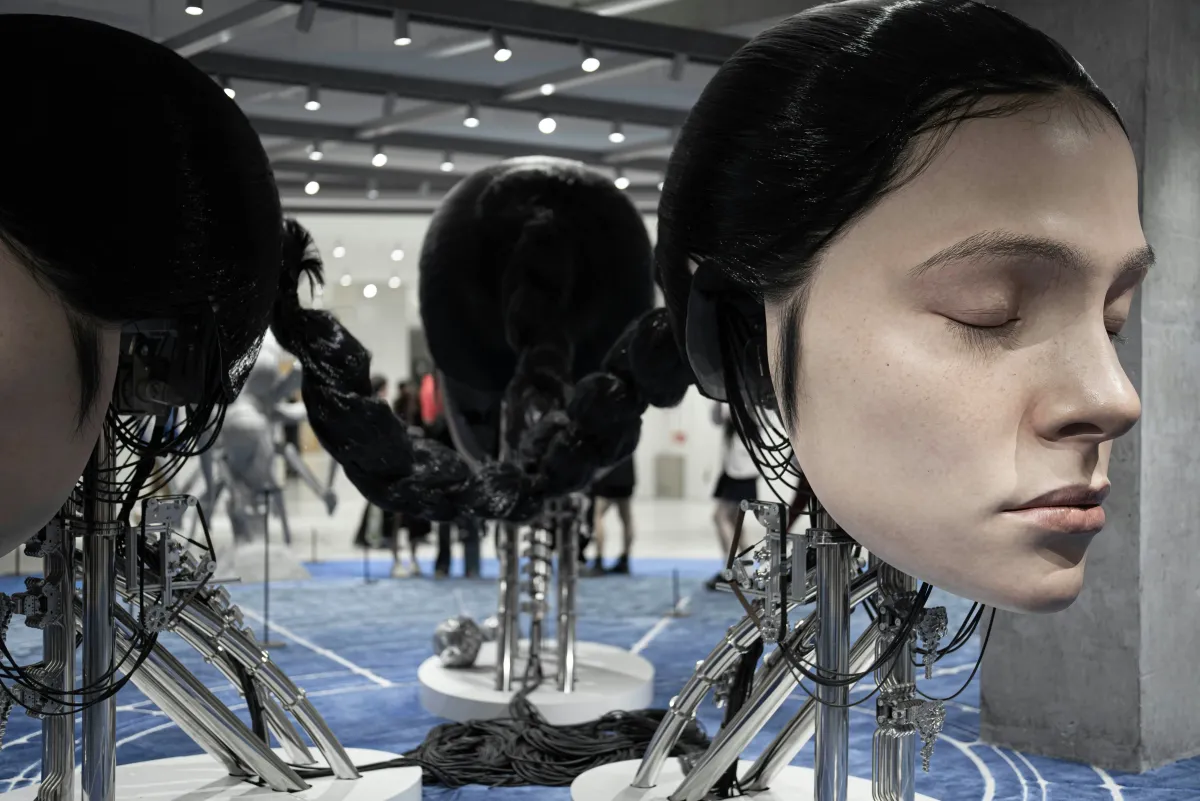 Photo by Donald Wu on Unsplash
Genuine micro-expressions are the currency of emotional connection. AI cannot yet replicate them at the subconscious level.
Photo by Donald Wu on Unsplash
Genuine micro-expressions are the currency of emotional connection. AI cannot yet replicate them at the subconscious level.
Why the Valley Won't Close Soon
AI video quality is improving rapidly. But the uncanny valley is not simply a resolution problem. It's a complexity problem.
Human facial expression involves the coordinated movement of over 40 individual muscles. Genuine emotion produces patterns of micro-expressions, tiny involuntary movements around the eyes, mouth, and brow, that last fractions of a second. These are the signals the brain's face-processing system is specifically tuned to detect.
Current AI models can generate plausible macro-expressions: a smile, a look of surprise, a frown. What they struggle with is the complex web of micro-expressions that accompany genuine feeling. The slight asymmetry of a real smile. The way the eyes narrow a fraction of a second before the mouth moves. The involuntary tension in the forehead during genuine surprise versus performed surprise.
These subtleties are exactly what the N170 and FFA are calibrated to detect. And they're exactly what separates a reaction clip that stops the scroll from one that gets scrolled past.
Working With Biology, Not Against It
The uncanny valley isn't a bug in human perception. It's a feature. It evolved to protect us from threats that mimic human appearance without actually being human. You can't engineer your way past it with better prompts or higher resolution.
What you can do is work with it. Use real human faces. Use real emotional expression. Use content where the configural processing, perceptual matching, and motion coherence all check out, because they were never artificial in the first place. Sourcing authentic content from a video marketplace built on user-generated reaction clips — rather than generating synthetic faces — means the uncanny valley problem simply doesn't arise.
The performance data is consistent: real faces outperform synthetic ones. The neuroscience explains why. And the practical implication is simple: for ad creative that depends on emotional connection, the human is not optional.
For tactical guidance on using real faces to stop the scroll, see The 1.5-Second Window: How Real Human Emotion Stops the Scroll.
Real creators. Real emotion. Ready to test in your next campaign. Browse the Catalog →
Sources
- Mori, M., "The Uncanny Valley," Energy journal, 1970 (translated 2012)
- UCSD / Ayse Pinar Saygin, fMRI parietal cortex mismatch study, ~2011
- ScienceDirect, "Uncanny valley effect: A qualitative synthesis of empirical research," 2023
- University of Sydney, EEG deepfake detection study, 2022
- Nature Scientific Reports, "Realness of face images decoded from EEG responses," 2024
- MIT thesis, "The Uncanny Valley: An Empirical Study on Human Perceptions of AI-Generated Text and Images," 2025
- MacDorman & Diel, configural processing and uncanny valley research
- Seyama & Nagayama, facial proportions and eeriness studies
- Animoto, "State of Video 2026 Report," January 2026
- SendShort, six-brand hook rate analysis