
Cultural Code-Switching in UGC: How Latin Creators Connect Across Audiences
Latin creators naturally code-switch between cultural contexts, creating UGC that resonates with Hispanic and general audiences simultaneously.
Code-switching usually refers to language: flipping between English and Spanish mid-sentence. But for Latin creators, code-switching runs deeper than vocabulary. It's cultural. It's tonal. It's a shift in energy, humor style, reference points, and emotional register that happens fluidly and unconsciously.
This cultural fluency is a strategic asset for brands that most creative teams don't even know they should be looking for.
What Cultural Code-Switching Actually Looks Like
Watch a bilingual Latin creator long enough and you'll see it. Recording a product review for a general-market audience, the energy is warm but measured. The language is English. The references are broadly accessible. The emotional expression is genuine but calibrated to mainstream norms.
The same creator, same product, recording for a Hispanic audience: the energy lifts. The language might shift to Spanish or Spanglish. The humor gets more specific. The facial expressions become more animated. The warmth increases. The entire register shifts, not because they're performing differently, but because they're communicating in a different cultural mode.
This isn't something you can teach a monolingual, monocultural creator to do. It's the product of growing up between cultures, navigating multiple social worlds daily, and developing an intuitive sense for what resonates in each context.
For UGC, where authenticity is the entire currency, this kind of intuitive cultural navigation produces content that feels native to whichever audience encounters it. The general-market version feels authentic to general-market viewers. The Hispanic-market version feels authentic to Hispanic viewers. Both are genuine. Neither is a translation.
Why This Matters for Platform Algorithms
Social platform algorithms optimize for engagement signals. Content that resonates with its audience earns distribution. Content that feels off-putting or irrelevant gets suppressed.
Code-switching creators produce content that is culturally calibrated for each audience segment. This means higher engagement rates within each segment, which means more algorithmic distribution, which means lower CPMs and broader reach.
The alternative, running the same generically produced content against both audiences, typically underperforms in at least one segment. Content produced for a general audience often feels flat to Hispanic viewers. Content produced specifically for Hispanic audiences sometimes doesn't translate to general-market contexts.
Code-switching creators solve this by producing genuinely different authentic content for each audience, all from the same source. The brand consistency comes from the creator's personality. The cultural specificity comes from their natural fluency. A video marketplace organized by creator profile — rather than by campaign brief — makes it straightforward to find Latin creators with documented cross-cultural range before you commit to a custom order.
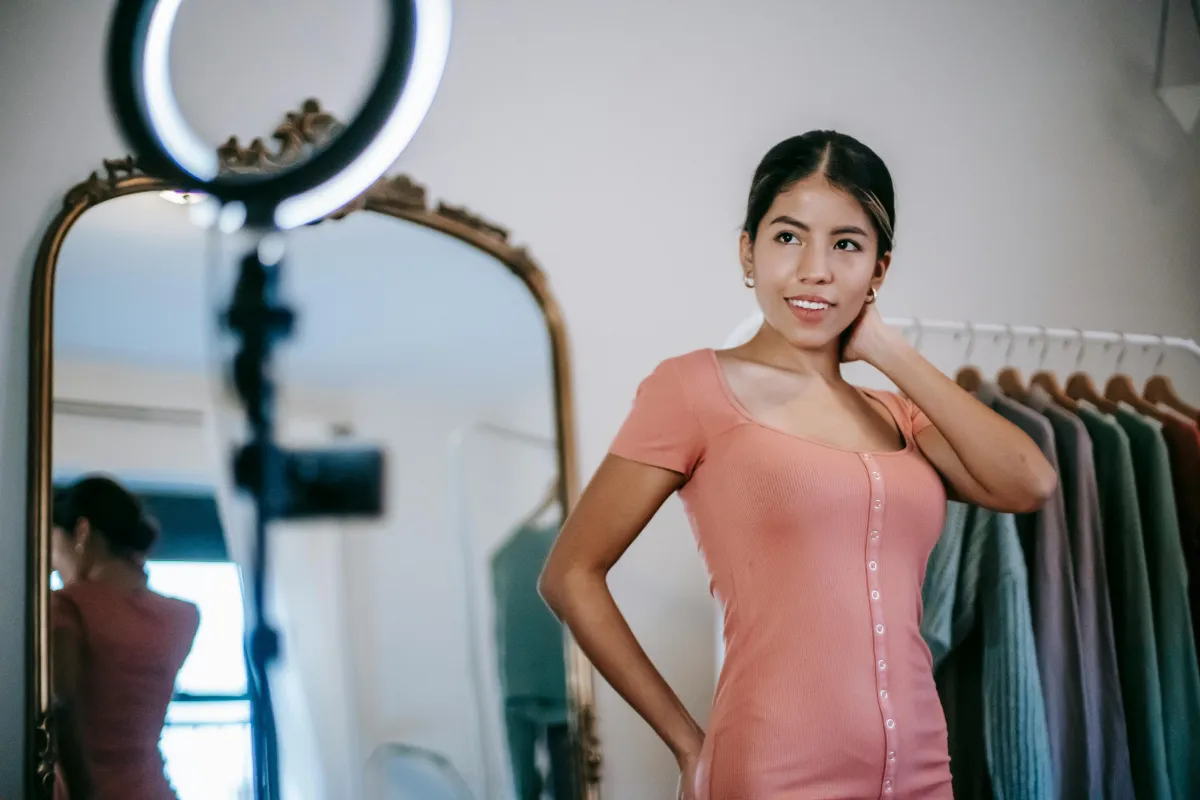 Code-switching creators produce culturally native content for multiple audiences from a single source.
The Trust Compound Effect
Cultural code-switching amplifies the trust mechanisms documented throughout this blog series.
Animoto's 2026 report shows 78% of consumers trust videos with real people. The facial trust research (see Why Your Brain Trusts a Stranger's Face) shows the brain makes snap trust judgments based on familiarity. And Latin creators' natural expressiveness increases the emotional signal that drives engagement.
Code-switching adds another layer: cultural familiarity. When a bicultural creator addresses a specific audience in that audience's cultural register, the viewer perceives not just a real person, but a real person who shares their cultural context. The trust signal compounds: real face plus emotional expressiveness plus cultural familiarity.
For the Hispanic market, where $3.4 trillion in buying power is at stake, this compounding trust effect translates directly to performance. Hispanic consumers who feel culturally seen by ad creative engage at higher rates than those who encounter culturally generic content.
The In-Between Space
What makes code-switching creators particularly valuable is their comfort in the in-between space. They're not fully "one culture" or "the other." They occupy a bicultural identity that gives them credibility in both worlds.
This is especially relevant for the U.S. Hispanic market, which is itself a spectrum. First-generation immigrants, second-generation bicultural Americans, third-generation English-dominant Hispanic Americans: each segment occupies a different position on the cultural spectrum. Code-switching creators, who live in this spectrum themselves, can calibrate their content to different points along it.
A creator producing a reaction video for a predominantly second-generation audience will naturally adjust their mix of English and Spanish, their cultural references, and their emotional expression to match. They're not working from a brief that says "target second-gen Hispanics." They're communicating in a register that's natural to them because they share that cultural position.
This nuance is invisible in a creative brief but immediately apparent on screen. And viewers respond to it. The 43% of consumers who say "personal and authentic" is the most important quality in video, per Animoto, are describing exactly this kind of culturally resonant authenticity.
Practical Applications for Brands
If you're running campaigns across both general and Hispanic audience segments, here's how to leverage code-switching creators:
Brief the creator on the product and the core message. Let them determine how to deliver it for each audience. Don't prescribe language mix or cultural references. The creator knows their audience better than any brief can capture. Review the output for brand consistency (messaging, product accuracy) but trust the cultural delivery.
The result will be multiple pieces of user-generated content from a single Latina creator, each culturally native to its target audience, each carrying the same emotional authenticity and expressiveness — and each cleared for commercial use with lifetime commercial rights from a single transaction. As explored in Bilingual Creators, Broader Reach, this approach is both more authentic and more efficient than sourcing separate creators for each audience.
Real creators. Real emotion. Ready to test in your next campaign. Browse the Catalog →
Sources
- Animoto, "State of Video 2026 Report," January 2026
- University of Sydney, "EEG detection of deepfake faces," published in Cognitive Research, 2022
- Industry data on UGC trust and performance, recent